What Is a Near Miss? Why Proactive Reporting Matters in Warehouses
Understand near-miss incidents in logistics. Learn Heinrich's safety triangle, common warehouse examples, reporting cultures, and accident prevention.
Logistics distribution centers, manufacturing shop floors, and freight terminals are fast-paced environments where heavy pallet loads, electric stackers, and walking personnel continuously interact. In these complex settings, catastrophic workplace accidents rarely happen without prior warning. Instead, they are preceded by minor mechanical anomalies, blind-spot close calls, and narrow escapes.
In occupational health and safety (OHS) standards, these early warnings are known as near-miss incidents. Because they result in no immediate personal injury or broken inventory, teams often brush them off as a "lucky break." In reality, an unaddressed close call is an early warning sign of a future incident. Establishing a proactive safety culture requires understanding what defines a near miss, how Heinrich’s safety pyramid applies to material handling, and how structured reporting prevents severe accidents.
What Is a Near Miss?
Under international OHS standards, a near miss is defined by a clear threshold:
Near Miss: An unplanned, unexpected event that had the potential to cause human injury, structural property damage, or operational disruption, but did not, solely due to chance, quick reflexes, or favorable timing.
The sole distinction between an actual workplace accident and a near miss is the final outcome. If a falling carton fractures an operator’s foot, it is classified as a reportable lost-time injury. If that same carton drops five inches away onto an empty aisle because a worker stepped back at the last second, it is a near miss. The underlying hazard—unstable pallet stacking or torn stretch wrap—remains identical.
Heinrich’s Safety Triangle: The Statistical Warning
Herbert William Heinrich’s foundational safety pyramid proves that serious industrial accidents do not strike at random. According to this statistical model:
- 300 Near Misses (unsafe acts or minor close calls), lead to
- 29 Minor Injuries / Minor Property Incidents, which ultimately result in
- 1 Major Lost-Time Injury or Fatality.
If a facility ignores the 300 near misses forming the base of the pyramid, reaching that single catastrophic event becomes a statistical certainty over time. Proactive safety management focuses entirely on logging and eliminating those bottom-tier warnings before they escalate up the chain.
4 Common Near-Miss Scenarios in Active Warehouses
Across high-throughput warehousing and logistics hubs, typical near-miss incidents occur during routine handling operations:
1. Blind-Spot Corner Encounters
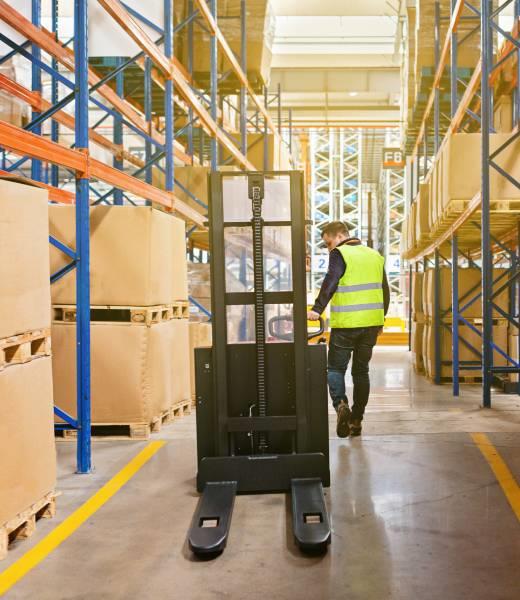
An electric walkie stacker emerges from a high-bay racking aisle just as a pedestrian crosses the junction, forcing the operator to drop the tiller into an emergency stop inches from the pedestrian. To establish comprehensive site defenses against such hazards, consult our baseline guide on the 8 golden rules for preventing warehouse accidents.
2. High-Elevation Pallet Deflections
While an operator seats a heavy pallet onto a beam at a 4-meter lift elevation, loose cartons slip from the pallet face and plummet to the ground floor. Because the drop zone was temporarily clear, no one was injured, but structural stacking integrity was clearly compromised.
3. Fluid Leaks and Slip Hazards
Small drops of hydraulic fluid leaking from an old pallet jack cylinder or a split bottle of industrial detergent create an invisible slick on an epoxy aisle. A worker slips and catches their balance on a racking upright without falling.
4. Pedestrian Shortcut Encroachment
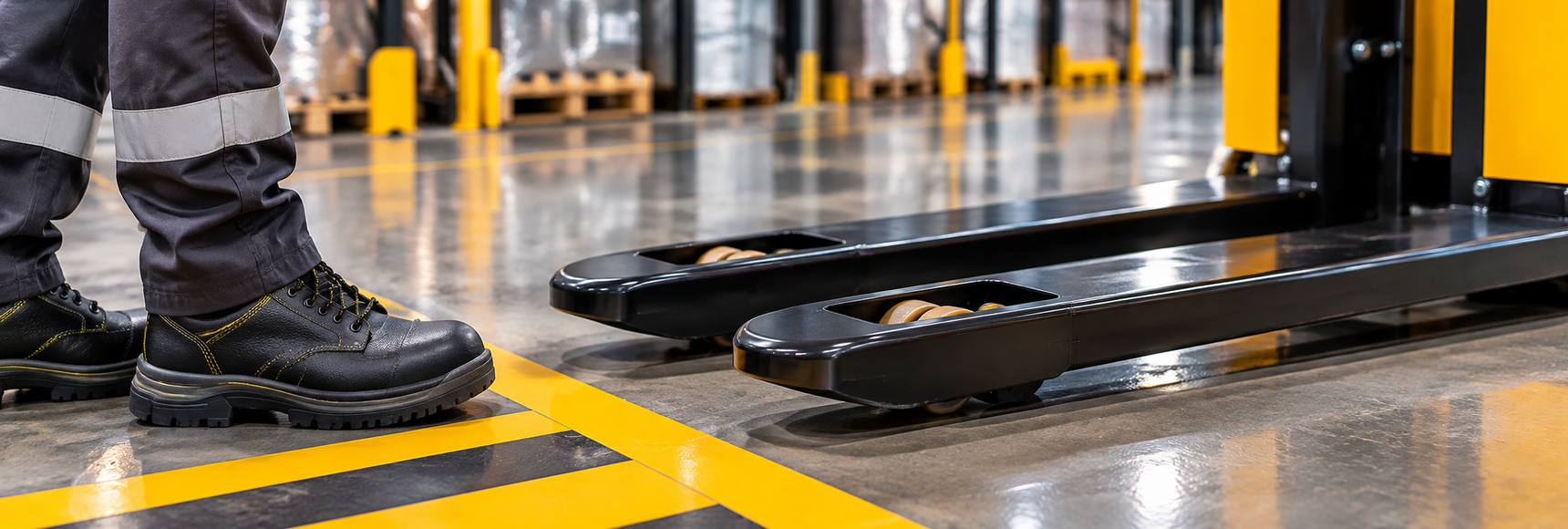
An on-foot employee cuts across an active vehicular transit lane rather than following marked safety barrier gates, stepping directly behind a reversing electric pallet truck whose operator brakes at the last fraction of a second. To properly segregate these workflows, explore our detailed methodology on how to safely separate pedestrian and vehicle traffic in warehouses.
How to Build an Effective Near-Miss Reporting Framework
A reporting workflow only succeeds if employees feel empowered to flag hazards rather than hiding them:
- Cultivate a "Just Culture" Without Blame: Staff must trust that reporting an unsafe condition or acknowledging a personal close call will not lead to disciplinary action or peer embarrassment.
- Streamline Submission Points: Remove friction by placing simple paper drop-boxes in break rooms and setting up intuitive digital portals or QR codes on aisle markers for instant mobile reporting.
- Conduct Root-Cause Analysis (The 5 Whys): OHS supervisors must look beyond surface errors. If a machine nearly hit a worker, evaluate whether blind-spot convex mirrors, blue-spot projection beams, or floor re-striping are needed.
- Close the Feedback Loop: When a near-miss report leads to a physical fix—such as installing rack column protectors or repairing a dock leveler—announce the change on team noticeboards so workers see that reporting drives tangible safety.
Every Reported Hazard Protects a Life
Treating near-miss incidents as minor coincidences leaves facility safety entirely to luck. Every narrow escape represents a clear opportunity to identify system weaknesses before someone gets hurt. With clear reporting channels, structured traffic layouts, and a proactive safety mindset, industrial facilities can eliminate hazards at their root.
To outfit your operations with modern handling machinery engineered with responsive emergency reversing switches, electromagnetic regenerative braking, and ergonomic tiller heads that reduce operator error, explore Paftar’s complete material handling range or contact our technical team for a site assessment.