How to Safely Separate Pedestrian and Vehicle Traffic in Warehouses
Master warehouse traffic management. Learn how to segregate pedestrian walkways from forklifts and pallet trucks using barriers, floor markings, and sensors.
Logistics centers, manufacturing warehouses, and freight terminals are dynamic environments where pedestrians, pallet trucks, electric stackers, and counterbalance forklifts operate side-by-side within confined spaces. Without a clear layout and disciplined traffic management, this high operational density introduces severe workplace hazards. In fact, nearly 40% of all serious warehouse injuries involve collisions between on-foot workers and mobile material handling equipment sharing uncontrolled travel paths.
Achieving a zero-incident operation without sacrificing logistical speed requires establishing a comprehensive warehouse traffic management plan that physically and visually isolates pedestrian flow from motorized machinery. Below is an actionable operational guide outlining the physical safeguards, visual standards, and spatial planning techniques needed to maximize site safety.
5 Essential Steps to Segregate Warehouse Traffic
To safely coordinate pedestrian movement with industrial handling units, facilities should enforce these five baseline engineering controls:
1. High-Visibility Floor Markings and Standard Color Schemes
Creating distinct, durable visual zones across the epoxy or concrete floor is the starting point of traffic segregation:
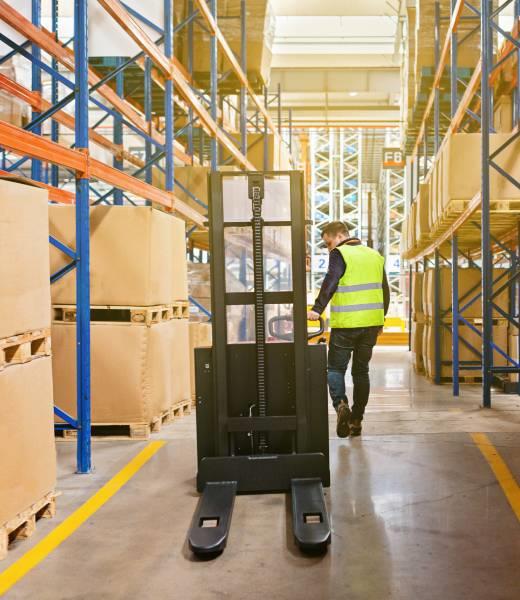
- Designated Pedestrian Walkways: Walkways dedicated strictly to foot traffic should be marked in bright yellow or solid green, reinforced with universal pedestrian walking pictograms.
- Vehicle Corridors: Travel lanes for pallet trucks and stackers must be defined with directional transit arrows, sized to accommodate equipment chassis widths and full turning radii.
- Exclusion Zones: Areas surrounding electrical switchboards, fire exits, and emergency eyewash stations must feature red-and-white diagonal cross-hatching to designate strictly prohibited parking zones.
2. Physical Safety Barriers and Impact Guardrails
Painted lines alone cannot stop heavy machinery during mechanical failure or operator error. In high-traffic intersections where pedestrian corridors run alongside equipment lanes, heavy-duty polymer or steel safety guardrails are critical. These shock-absorbing barriers physically prevent machinery from veering into pedestrian lanes while stopping workers from stepping blindly into moving traffic.
3. Blind-Spot Management with Convex Panoramic Mirrors
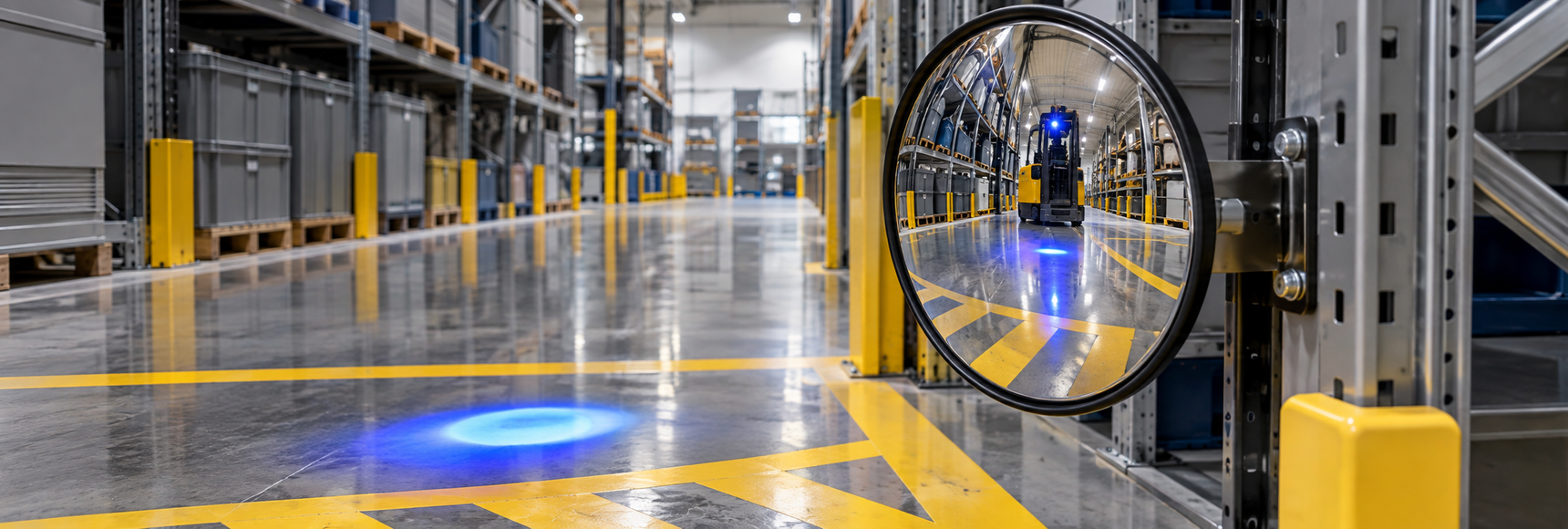
Aisle intersections, rack ends, and entrance portals represent dangerous blind spots where visibility drops to zero. Installing industrial convex mirrors at these intersections gives operators and pedestrians an early line of sight, allowing drivers to reduce approach speeds and helping pedestrians confirm when crosswalks are clear.
4. Active Visual and Acoustic Warning Systems
In loud distribution hubs, acoustic vehicle alarms can blend into ambient machinery noise. Visual warning technologies provide a proactive layer of awareness:
- Blue-Spot Light Projections: Projecting a focused, high-intensity blue LED beam 4 to 5 meters onto the floor ahead of or behind an approaching vehicle alerts cross-traffic well before the chassis exits a blind aisle.
- Red Boundary Halo Lights: Projecting crisp red perimeter lines along the sides of the equipment establishes a visible exclusion zone that pedestrians must not cross.
5. Regulated Crosswalks and Interlocking Gate Systems
Where pedestrian paths must cross vehicle transit corridors, formal zebra crossings should be designated alongside "Stop, Look, and Listen" signage. At high-velocity transit crossings, facilities should deploy smart gates linked to motion sensors that display red warning lights to pedestrians or automatically slow approaching machines. To reinforce facility-wide protocols, review our practical guide on the 8 golden rules for preventing warehouse accidents.
Behavioral Discipline in Forklift and Pedestrian Safety
Engineering controls must be backed by strict human behavioral standards. To establish effective on-site safety habits, enforce these daily rules:
- Direct Eye Contact Rule: Pedestrians must never walk across an active equipment corridor without making direct eye contact with the operator and waiting for a clear nod or wave to cross.
- 3-Meter Exclusion Radius: Pedestrians must maintain a minimum 3-meter safety perimeter around any machine actively lifting, lowering, or staging pallets.
- No Distractions Policy: Earbuds, mobile phone usage, and personal devices must be strictly banned for anyone walking or operating equipment on the facility floor.
Structured Traffic Drives Safety and Throughput
Segregating pedestrian movement from motorized material handling equipment is an operational investment that eliminates chaos, prevents costly equipment impacts, and protects personnel. A well-planned traffic architecture ensures smooth goods flow while giving facility teams the confidence to operate at peak efficiency.
To discover compact, narrow-aisle electric handling equipment engineered with advanced electromagnetic braking and ergonomic steering to protect facility teams, explore Paftar's complete industrial catalog or contact our material handling engineers for a tailored site assessment.