Safety Rules for Loading and Unloading: Preventing Warehouse Accidents
Prevent severe loading dock accidents. Learn essential safety rules covering trailer creep, dock levelers, load balance, and pedestrian segregation.
Across distribution centers, manufacturing warehouses, and logistics hubs, loading and unloading docks represent the most active, high-tempo, and hazardous zones in the material handling cycle. Serving as the primary interface between internal facilities and road transport, loading bays create a dynamic environment where pedestrians, electric pallet trucks, stackers, and commercial semi-trailers intersect continuously.
Workplace accidents in these zones—ranging from load collapses and trailer separation to crush injuries in dock levelers and falls from heights—can result in severe human harm and massive logistical disruption. Achieving a zero-incident operation requires integrating disciplined engineering safeguards with strict daily operating standards. Below is an essential operational guide outlining the core safety rules for loading and unloading workflows.
5 Critical Safety Rules for Loading and Unloading Operations
To eliminate physical hazards and maintain steady freight velocity across warehouse staging bays, facilities must enforce these five core protocols:
1. Trailer Restraint and Wheel Chock Deployment
One of the most dangerous hazards in dock operations is "trailer creep" (dock walk). Every time an electric pallet truck or forklift enters a semi-trailer, the forward momentum pushes the vehicle slightly away from the dock face. To eliminate the risk of machinery falling through the resulting gap:
- Engage trailer air brakes, set mechanical parking brakes, and shut off engines during loading cycles.
- Securely wedge heavy-duty rubber or steel wheel chocks against the rear tires on both sides of the vehicle.
- Where available, deploy automated vehicle restraint systems (dock locks) that physically anchor the trailer's rear impact guard (RIG) to the dock structure until loading is complete.
2. Dock Leveler and Bridging Plate Stability
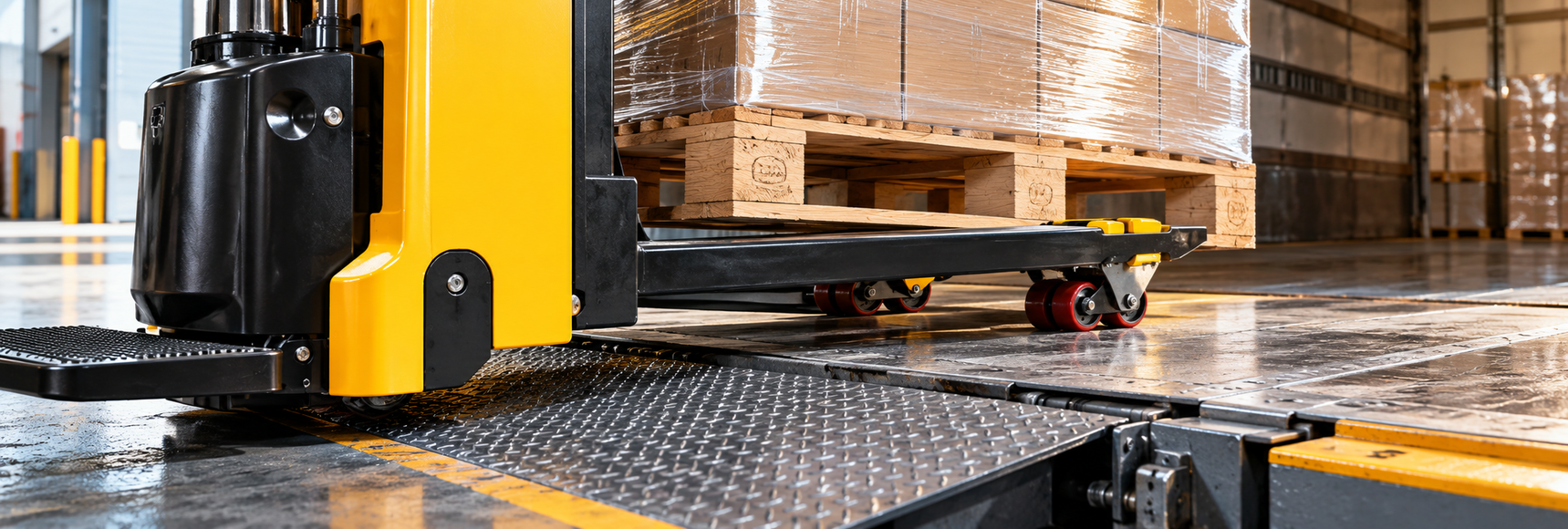
Hydraulic dock levelers and bridging plates must provide a seamless, non-slip transition between the warehouse floor and the trailer bed. Verify that the leveler lip extends sufficiently onto the vehicle bed to prevent slippage under dynamic loads. Keep dock surfaces clear of water, oil, and ice, and verify that the leveler slope does not exceed the maximum operational grade of your handling equipment.
3. Symmetric Cargo Weight Distribution and Stability
Unstable stacking risks catastrophic collapses both during staging and subsequent transit:
- Distribute heavy pallets evenly along the trailer floor and directly over axle sets rather than concentrating mass at the nose or tail.
- Keep load centers positioned flush against the fork face; never transport cargo precariously perched on fork tips.
- Secure empty voids with dunnage bags, load locks, or ratchet straps to prevent cargo shifting during transport.
4. Segregation of Pedestrian and Mobile Equipment Traffic
Loading bays often suffer from compromised sightlines and loud ambient noise. An operator reversing an electric pallet truck out of a dark trailer bed may fail to see an on-foot worker walking behind the vehicle. Facilities should establish physically barrier-protected pedestrian walkways and strictly bar unauthorized personnel from entering active dock aprons. For broader operational protocols, explore our practical guide on the 8 golden rules for preventing warehouse accidents.
5. High-Intensity Dock Bay Illumination
Standard sunlight rarely penetrates deep inside 53-foot trailers or shipping containers. To identify cracked floorboards, broken pallet blocks, or loose cargo, install adjustable, articulating dock arm lights at every bay. Bright, targeted illumination prevents missteps, reduces visual fatigue, and protects technicians from trip-and-fall hazards.
Equipment Selection and Operator Competence
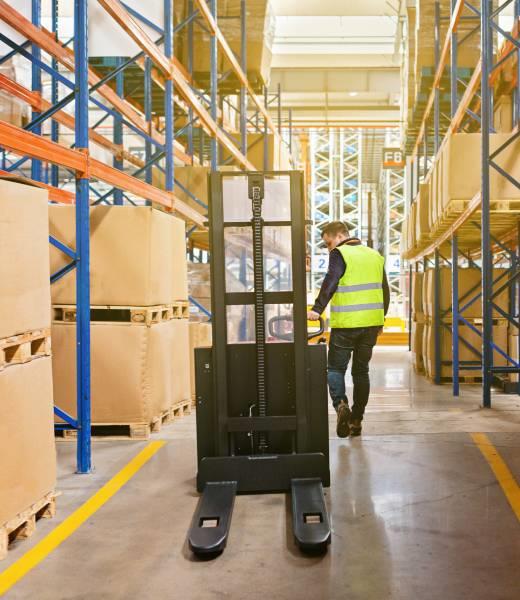
Handling heavy goods manually across loading ramps causes severe musculoskeletal injuries and slows turnaround times. Upgrading to ergonomic pedestrian electric pallet trucks or compact walkie stackers streamlines cycle speed while protecting worker physical health.
Furthermore, operators navigating loading ramps must be thoroughly trained in slope dynamics:
- Always keep the payload pointed uphill when negotiating inclined dock ramps (forks facing up the ramp during ascent; reverse travel during descent).
- Never turn a loaded machine across an incline, as lateral shifts can trigger an immediate tip-over.
- Operators must never stand downhill of an active motorized pallet truck on a ramp.
Disciplined Operations Drive Safe Freight Velocity
Loading docks represent the vital gateway connecting your facility to the global supply chain. Establishing clear trailer restraint protocols, proper load balancing, and structured traffic segregation protects your workforce while eliminating freight damage and legal liabilities. Combining certified equipment with rigorous training ensures that fast-paced operations remain safe, smooth, and fully compliant.
To equip your loading docks with heavy-duty, compact electric pallet trucks and handling machinery engineered for tight maneuvers and high slope stability, explore Paftar's full industrial catalog or connect with our engineering team for specialized site assessments.