Do You Need a License to Operate a Stacker? Certification & Legal Guide
Do you need a driving license or an operator certificate for a stacker? Learn legal operator requirements, training standards, and certification rules.
Across distribution hubs, production facilities, and retail logistics centers, stacker trucks serve as indispensable assets for vertical load staging and high-bay pallet racking. However, when onboarding staff or reviewing facility compliance, warehouse managers and operators often encounter confusion regarding legal qualifications: Do you need a driving license to operate a stacker truck?
In the industrial sector, terms like "driver's license" and "operator certificate" are frequently used interchangeably, yet legally and functionally, they serve distinct regulatory purposes. Stacker trucks operate strictly within private facility perimeters and off public highways. Below is a comprehensive breakdown of the mandatory qualifications, workplace health and safety compliance rules, and operator competencies required to run stackers safely.
Driver's License vs. Operator Certificate: The Key Distinctions
To ensure full compliance with occupational health and safety (OHS) regulations, facilities must distinguish between roadway driving permits and internal equipment certifications:
- Roadway Driver’s License: Issued by national traffic authorities for motor vehicles driven on public highways. Because industrial stackers are confined to private warehouses and gated yards, a standard motor vehicle license does not grant legal authorization to operate lifting machinery inside a plant.
- Certified Operator Certificate: An accredited vocational credential granted by certified training bodies in alignment with workplace safety standards. This document verifies that the technician possesses the theoretical knowledge and physical skill required to safely control vertical lifting equipment within private industrial facilities.
For an overview of how heavy lifting machinery integrates with specialized roadway classes and heavy equipment licenses, review our step-by-step guide on how to get a forklift license step by step operator guide.
Certification Requirements by Stacker Category
Operator qualification standards depend directly on the drive system, chassis design, and mechanical configuration of the machine:
1. Manual Hydraulic Stackers
Hand-pumped or foot-pedal mechanical stackers do not require a government-accredited motorized equipment license. However, workplace safety laws still mandate that employers provide internal training covering lifting ergonomics, balance stability, and safe manual handling procedures before assigning staff to these units.
2. Pedestrian Walk-Behind (Electric) Stackers
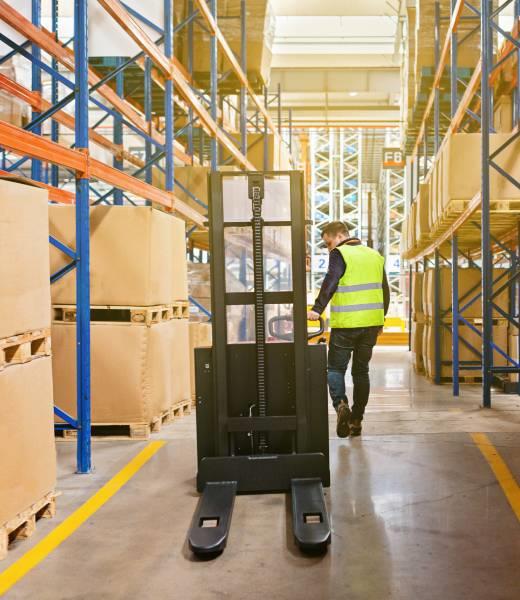
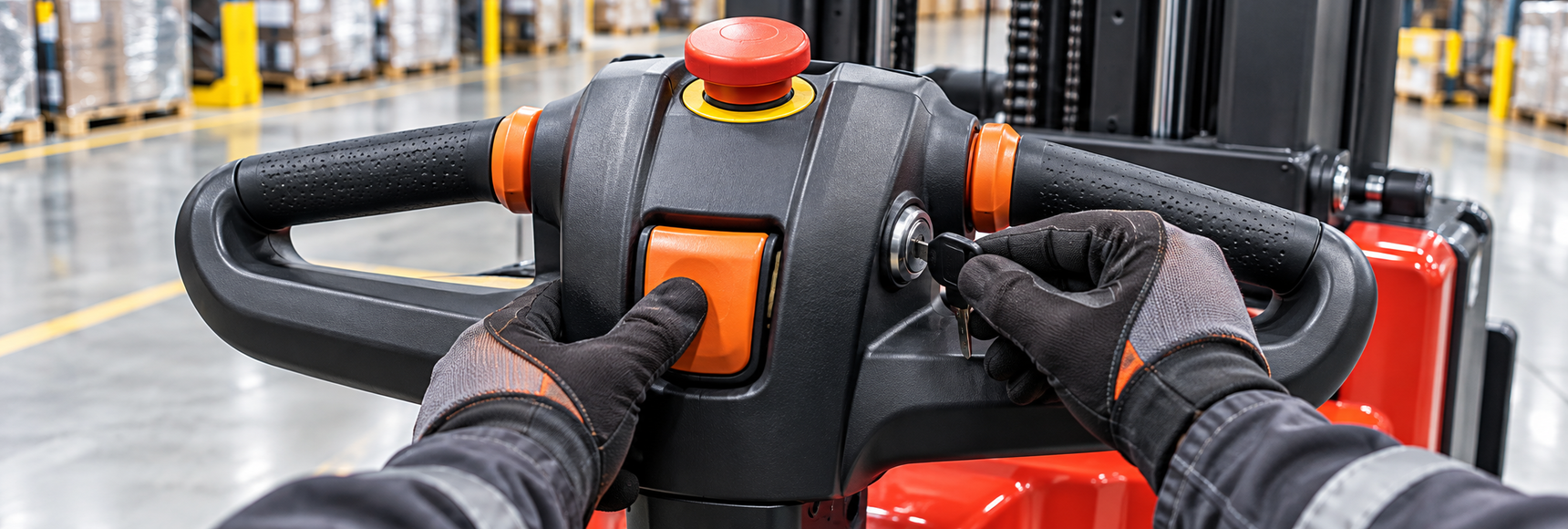
Walkie stackers integrate motorized drive systems and high-pressure hydraulic lift mechanisms controlled via an ergonomic tiller head. While they do not fall under conventional ride-on vehicle laws, any technician serving as a stacker truck operator must complete formal operational training. This ensures proficiency with emergency belly-reverse mechanisms, upright deadman braking, and residual capacity reduction at height, backed by an employer-authorized stacker operating authorization.
3. Ride-On and Stand-On Platform Stackers
High-lift units equipped with foldable operator platforms or dedicated sit-down driver cabins operate at higher travel velocities and greater mast elevations. Operating ride-on equipment legally mandates an accredited Material Handling & Lifting Machinery Operator Certificate issued by certified training academies.
The Operator Certification and Training Process
Earning an accredited operator qualification or certifying internal personnel requires completing four core training modules:
- Eligibility Verification: Candidates must meet minimum working age standards (typically 18 years old) and pass an occupational fitness medical examination verifying physical capability for machinery operation.
- Theoretical Instruction: Covers OHS regulations, center-of-gravity physics, load center charts, pallet stability, hydraulic system fundamentals, and daily pre-shift inspection routines.
- Practical Maneuvering Assessment: Conducted under certified examiner oversight, trainees must demonstrate smooth navigation through narrow aisles, level fork insertion, balanced load retrieval from elevated racks, and emergency stop deployment.
- Credential Issuance: Candidates who pass both written and practical examinations receive a formal operator credential valid for internal industrial operations.
The Legal and Operational Risks of Uncertified Operation
Allowing unauthorized or untrained personnel to operate electric stackers introduces severe liabilities for facility management:
- Regulatory Penalties: Labor and safety inspectors impose severe administrative fines on enterprises permitting uncertified personnel to handle motorized lifting machinery.
- Insurance Forfeiture & Direct Liability: In the event of a rack impact, tip-over, or worker injury, insurance providers routinely deny coverage if the machine was driven by an uncertified operator, leaving the employer fully exposed to civil litigation and third-party damages.
- Operational Inventory Damage: Unskilled handling leads to buckled rack uprights, shattered pallets, dropped inventory, and damaged hydraulic seals.
To outfit your facility with dependable equipment engineered with responsive tiller controls, automatic speed limits, and advanced safety systems, explore our full lineup of Paftar stackers.
Qualified Operators Build Safe Warehouses
Operating a stacker inside a private distribution center or manufacturing plant does not demand a standard highway driving license, but it strictly requires an accredited stacker operator certification. No matter how advanced the machine's safety technology is, an operator who understands dynamic load centers, mast limits, and travel clearances remains your first line of defense against warehouse accidents.
To select pedestrian, ride-on, or specialized vertical lifting equipment tailored to your aisle geometry and pallet configurations, browse Paftar’s comprehensive machinery catalog or speak with our material handling specialists today.