What is a Pedestrian Stacker? Key Advantages for Modern Warehouses
Learn how pedestrian stacker trucks operate, their core advantages over manual and ride-on units, lift heights, and agility in narrow warehouse aisles.
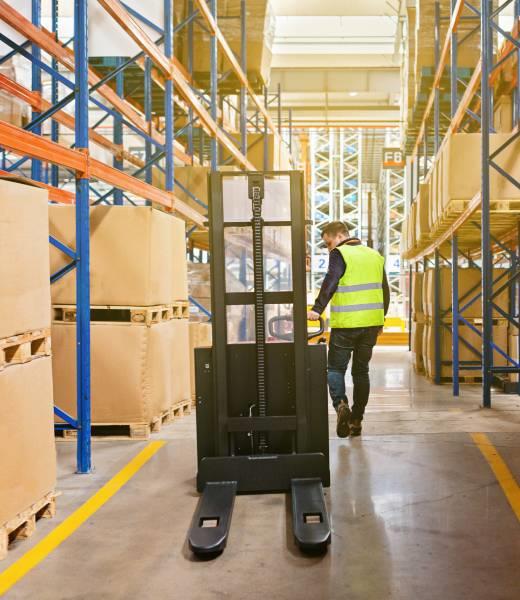
In modern logistics facilities, manufacturing workshops, and distribution terminals, maximizing floor space utilization has made vertical high-bay storage indispensable. When positioning or retrieving palletized cargo from racking systems, heavy industrial forklifts are not always the most practical or economical choice. In narrow aisles, low-ceiling spaces, or confined staging areas, compact handling equipment with superior maneuverability becomes essential.
This is where pedestrian walkie stackers deliver substantial value by slashing operating expenses while elevating operator ergonomics. Rather than requiring the driver to sit in a cabin or ride on a standing platform, the operator controls the unit by walking behind it and guiding an ergonomic control arm (tiller handle). This setup transforms vertical load handling into a safe, controlled, and flexible workflow.
How Does a Pedestrian Electric Stacker Work?
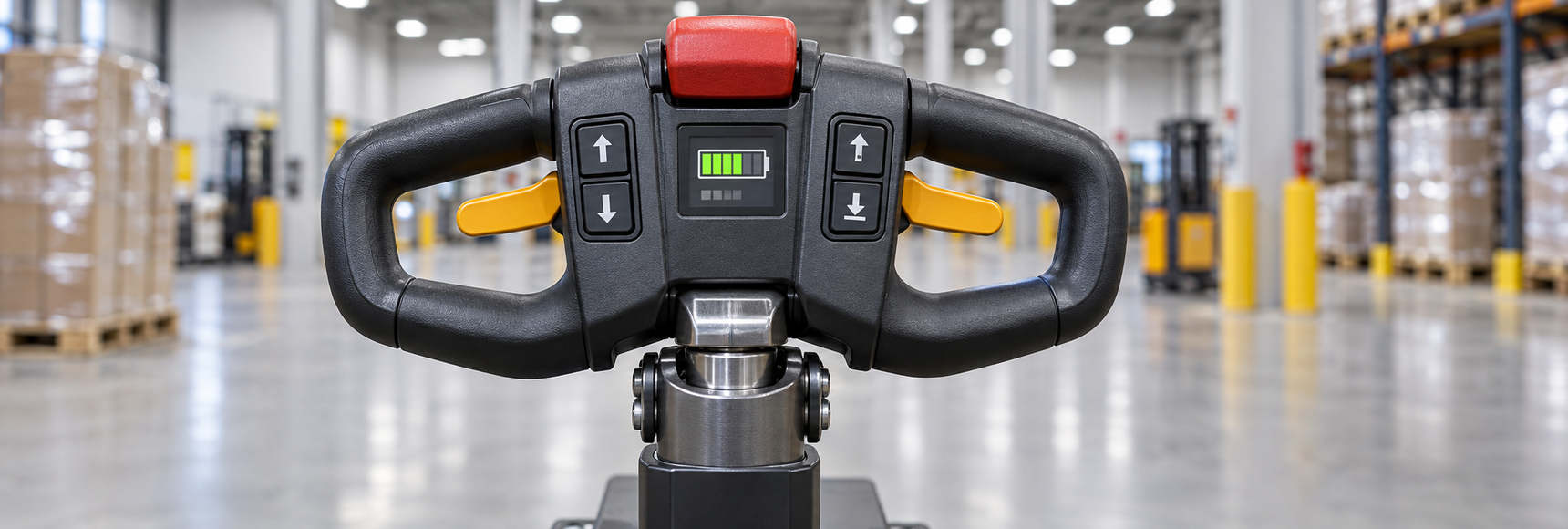
A walkie stacker is a fully motorized electric stacker truck equipped with dedicated drive and hydraulic lift motors. Every operational command—travel speed, dynamic braking, and fork elevation—is executed via intuitive controls integrated into the tiller head:
- Ergonomic Steering Controls: Operators manage proportional forward and reverse travel using ergonomic butterfly throttle switches, while push buttons control millimeter-precise hydraulic fork lifting and lowering.
- Built-in Safety Mechanisms: An emergency belly-reversing button mounted on the head of the tiller handle instantly reverses travel direction if it contacts the operator's torso, preventing body-crush accidents in tight corridors.
- Automatic Deadman Braking (Tiller Braking): Releasing the control arm completely upright or pressing it fully downward immediately engages electromagnetic disc brakes to bring the unit to a fail-safe stop.
Comparison: Pedestrian vs. Manual and Ride-On Platform Systems
Selecting the ideal equipment requires evaluating the structural differences between manual hydraulic stackers and ride-on platform units:
1. Advantages Over Manual Hydraulic Stackers
Hand-pumped manual stackers serve light, low-frequency tasks, but they cause severe physical fatigue and lost productivity during intensive work shifts. In contrast, an electric pedestrian walkie stacker automates both travel and lifting cycles via high-torque electric motors, eliminating repetitive strain injuries, tripling cycle speeds, and maintaining consistent workflow efficiency.
2. Advantages Over Ride-On Platform Units
Foldable standing-platform stackers are built for long-distance horizontal travel across vast distribution yards. However, in high-density racking aisles, a platform extends overall chassis length ($L_2$) and expands the turning radius. Walk-behind pedestrian stacker configurations eliminate the rear platform, enabling the machine to pivot tightly within narrow aisle widths ($A_{st}$) to maximize warehouse storage density.
Target Facility Applications
Thanks to their tight turning radius and slim chassis profile, pedestrian walk-behind stackers deliver outstanding productivity across diverse facilities:
- Narrow-Aisle Warehouses: High-density storage facilities where standard counterbalance forklifts cannot navigate or turn between rack bays.
- Manufacturing and Assembly Plants: Mid-sized production bays feeding raw components and sub-assemblies directly to assembly lines.
- Retail Backrooms and Supermarkets: In-store and back-of-house replenishment requiring quiet, zero-emission, and fume-free vertical pallet handling.
- Multi-Story Logistics Facilities: Operations using freight elevators, where the stacker's light service weight easily complies with floor and hoist load restrictions.
Depending on your racking heights and duty cycles, Paftar offers versatile mast configurations ranging from 1600 mm single-stage duplex masts to triple-stage masts reaching 4600 mm and above. Explore our complete selection of heavy-duty battery-powered stacker equipment to find the exact lifting profile your facility requires.
Superior Agility, Lower Capex, and Operator Ergonomics
Pedestrian electric stackers provide warehouse managers with an ideal balance: achieving vertical stacking performance without the high capital investment, maintenance costs, and space requirements of full-sized forklifts. Featuring advanced lithium-ion or robust traction battery options, low energy consumption, and high maneuvering agility, they accelerate cycle times while safeguarding shop-floor personnel.
To review certified, heavy-duty stacker truck models engineered for your specific tonnage and elevation requirements, browse Paftar's complete industrial machinery portfolio or consult our engineering sales specialists for tailored site assessments.