Scissor Lift vs. Manlift: Which Aerial Work Platform Is Right for You?
Compare the key differences between scissor lifts and manlifts for high-altitude jobs. Choose the right aerial work platform for your project layout.
Across construction yards, manufacturing plants, external facade projects, and distribution facilities, high-altitude assembly, installation, and maintenance operations represent some of the most safety-critical workflows in modern industry. Replacing conventional scaffolding with certified aerial work platforms (AWPs) not only elevates workplace safety but also shortens project completion timelines.
However, when organizing high-elevation tasks, engineering and facility managers frequently confront the core dilemma: What is the difference between a scissor lift and a manlift, and which machine suits specific operational layouts? To establish the ideal strategy for choosing the right equipment for working at heights, let us examine the mechanical kinematics, reach capabilities, and practical application profiles of both equipment families.
Fundamental Differences Between Scissor Lifts and Manlifts
While both platforms are engineered to elevate personnel and tools safely, their structural articulation and geometric capabilities serve completely different industrial functions:
Direction of Motion & Geometry: Scissor lifts utilize linked hydraulic pantograph mechanisms that move strictly along a vertical (up-and-down) axis directly above the chassis footprint. Manlifts (particularly articulated boom lifts and telescopic boom lifts) provide vertical elevation combined with significant horizontal outreach, allowing them to bridge over ground-level obstructions and rotate the operator basket across 360 degrees.
Deck Surface & Safe Working Load (SWL): Scissor lifts feature large, elongated work decks and high load capacities, allowing multiple technicians, heavy power tools, and bulky installation hardware to be elevated together. Manlift baskets are smaller and engineered to support one or two operators with essential hand tools.
Maximum Reach Limits: Standard industrial scissor lifts typically operate within reach envelopes of 6 to 18 meters. In contrast, telescopic and articulated boom manlifts achieve working heights extending from 15 meters to well over 45 meters.
Which Aerial Work Platform Matches Your Facility Layout?
Matching your equipment to site-specific physical barriers and geometric constraints ensures maximum productivity and safety:
Scissor Lift Applications
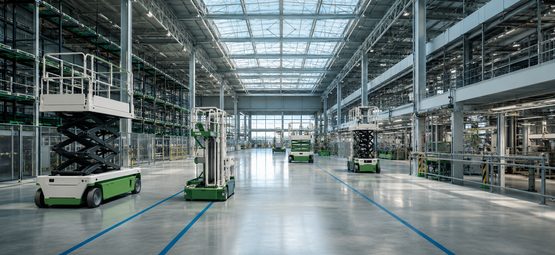
A scissor lift is the top choice when the chassis can be positioned directly beneath the work area and the job requires a large platform space or high lifting tonnage. Common use cases include:
Installing indoor overhead LED lighting, fire sprinkler grids, and HVAC duct networks
Assembling high-bay warehouse racking systems and vertical logistics maintenance
Executing facade painting, drywall paneling, and flat-wall structural cladding
To explore high-stability electric and rough-terrain vertical units tailored to your project, browse our scissor lift portfolio.
When to Choose a Manlift?
When physical obstacles on the ground (such as pipelines, heavy machines, drainage channels, or structural overhangs) prevent positioning directly below the work target, a boom lift is essential. Key scenarios include:
Reaching over active factory production lines to service overhead bridge cranes or roof trusses
Installing structural steel, curtain walls, and exterior glazing on complex building architectures
Performing maintenance across shipyards, wind turbine towers, and high-voltage transmission lines
To discover advanced vertical and horizontal reach capabilities across various articulated and telescopic configurations, explore our complete manlift range.
Maximize Safety and Throughput with Site-Specific Equipment
Choosing between a scissor lift and a manlift comes down to analyzing your physical trajectory and payload. For vertical-only tasks requiring spacious decks and heavy payloads, scissor lifts offer the most cost-effective and balanced solution. When jobs demand maneuvering around complex obstacles or reaching extreme heights with horizontal extension, boom-style manlifts provide unrivaled versatility. Analyzing ground stability, required working envelope, and gross payload before procurement prevents costly job-site bottlenecks and ensures full regulatory OHS compliance.
To evaluate certified aerial work platforms engineered to meet international safety criteria under demanding industrial conditions, explore Paftar's full product catalog or connect with our technical engineers for tailored equipment recommendations.